
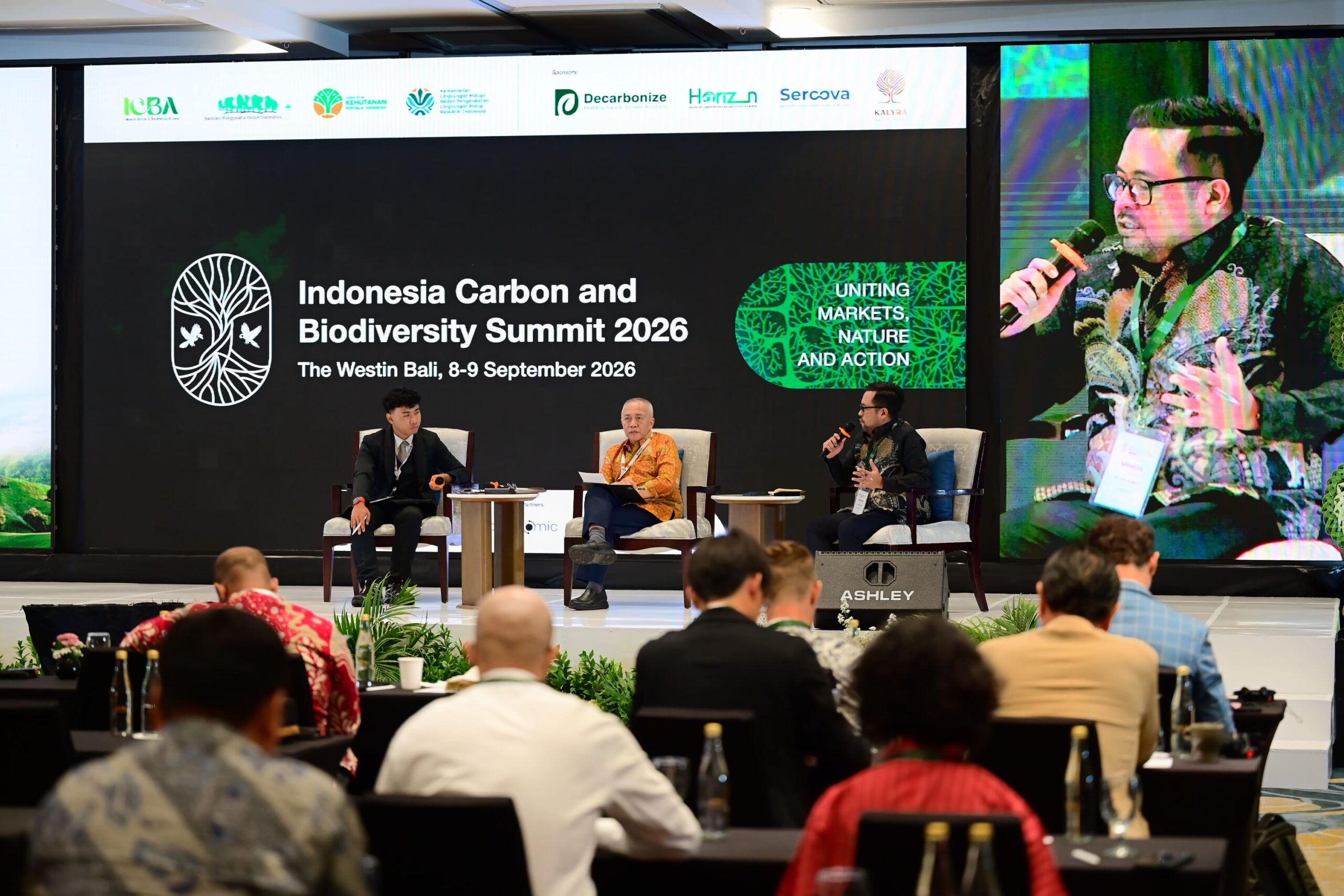
Funding Conservation for National Parks: What Carbon Finance Can and Can't Do, a Reflections from ICBS 2026
Conserving Indonesia’s national parks is a long-term responsibility, and sustaining that work requires equally long-term sources of finance.
That was the practical starting point for the “Funding Conservation for National Parks” discussion at the Indonesia Carbon and Biodiversity Summit (ICBS) 2026, where our COO, Zulfan Herman, joined a conversation on how carbon finance might complement existing conservation funding while keeping ecological integrity, community participation, and the core purpose of national parks firmly at the centre.
A Conservation Challenge Measured in Millions of Hectares
Moderated by Rizka Afif of Canopy Carbon, the discussion brought together Dr. Ir. Wiratno, former Director General of Conservation of Natural Resources and Ecosystems, and Zulfan Herman of Decarbonize Indonesia, combining decades of experience in national park management with a carbon project and financing perspective.
The scale of the challenge came through clearly. Wiratno described a protected-area system covering tens of millions of hectares, surrounded by thousands of villages and communities whose livelihoods are closely connected to these landscapes. His experience managing national parks has reinforced a simple principle: local people must be treated as partners in conservation, not as a consideration added later.
Tangkahan in Leuser offered one of the clearest examples of this in practice. Community-based ecotourism created an alternative economic opportunity in an area previously affected by logging. Over time, protection of the area allowed forest recovery without a large-scale planting programme, demonstrating what can happen when conservation and local economic incentives begin to reinforce one another.
Where Carbon Finance Actually Fits
The discussion then turned to where carbon finance could fit into this picture. Zulfan emphasised that carbon should be considered a supplementary source of conservation finance, rather than a replacement for existing public responsibilities. That makes additionality particularly important in national parks, where conservation already carries a legal mandate. His practical test was straightforward: “what won’t happen without carbon financing?”
That question shifts the focus toward real gaps on the ground. If deforestation pressure is increasing, restoration needs remain unfunded, or management capacity is insufficient, carbon finance may be able to support additional interventions. But those interventions need to address the underlying causes of degradation, not simply finance activities that were already required or expected.
The same principle applies to project readiness. Not every national park faces the same threats, ecological conditions, or management challenges. Additionality, MRV, permanence, carbon rights, community and Indigenous rights, safeguards, and benefit sharing all need to be assessed in the context of the individual landscape, rather than assuming a single model can be applied across the entire national park system.
Carbon Is One Value Among Many
The conversation also placed carbon within a much wider view of natural value. Wiratno argued for looking at the total economic value of a park, including water, biodiversity, non-timber forest products, clean air, and ecotourism. In his words, “the value of the park is not only carbon.” Carbon can contribute to the financing mix, but it represents only one part of the environmental and economic services that protected landscapes provide.
That broader perspective matters just as much when it comes to communities and benefit sharing. Questions around who participates, how revenues are distributed, what rights need to be recognised, and how local people benefit from conservation finance will ultimately shape the credibility and durability of any project developed within or around protected areas.
Collaboration as the Real Foundation
The session closed on a point that extended beyond any single financing instrument. “Doing nature protection, we need collaboration,” Wiratno said. “In collaboration we need mutual respect, mutual trust, and mutual benefit.” Zulfan echoed this, emphasising the need for government, investors, park managers, and communities to be involved in building projects with clear additionality, strong safeguards, and credible benefit-sharing arrangements.
What This Means for Indonesia’s Protected Landscapes
Carbon finance could become an important additional tool for supporting Indonesia’s national parks, but its role should be defined by the needs of the landscape: where financing gaps exist, where additional conservation outcomes can be demonstrated, and where local communities can participate meaningfully in the benefits. The objective remains stronger, more durable conservation. The financing mechanism should help make that possible, not define it.
As a carbon project developer working across Indonesia’s forest landscapes, this distinction sits at the centre of how Decarbonize approaches conservation financing. Carbon is a tool we take seriously, but never the whole story. Every project we develop is built around the same test Zulfan raised on stage: identifying what genuinely won’t happen without additional financing, and designing around real gaps rather than convenient ones.
Thank you to Rizka, Pak Wiratno, and Pak Zulfan for a thoughtful discussion on the role new sources of finance can play in supporting Indonesia’s protected landscapes.
Working on a conservation or protected-area financing challenge? Talk to the Decarbonize Indonesia team about where carbon finance genuinely fits.
This article is adapted from a session recap originally shared by ICBA (Indonesia Carbon & Biodiversity Alliance) following the “Funding Conservation for National Parks” panel at ICBS 2026.
Read More Our Articles

Your Strategic Pathway to a Net Zero Future
Or contact us directly

Jl. Prof. Joko Sutono SH No.7, RT.14/RW.6, Petogogan, Kec. Kby. Baru, Kota Jakarta Selatan, Daerah Khusus Ibukota Jakarta 12160
Email: contact@decarbonize.id
WhatsApp: 0813-1406-0000

Jl. Prof. Joko Sutono SH No.7, RT.14/RW.6, Petogogan, Kec. Kby. Baru, Kota Jakarta Selatan, Daerah Khusus Ibukota Jakarta 12160
Kode Pos: 12160
Email: contact@decarbonize.id
WhatsApp: 081234567890
© 2026 Decarbonize Indonesia. All rights reserved.