
Inside Indonesia's New Carbon Market Architecture
ICBS 2026 Throwback
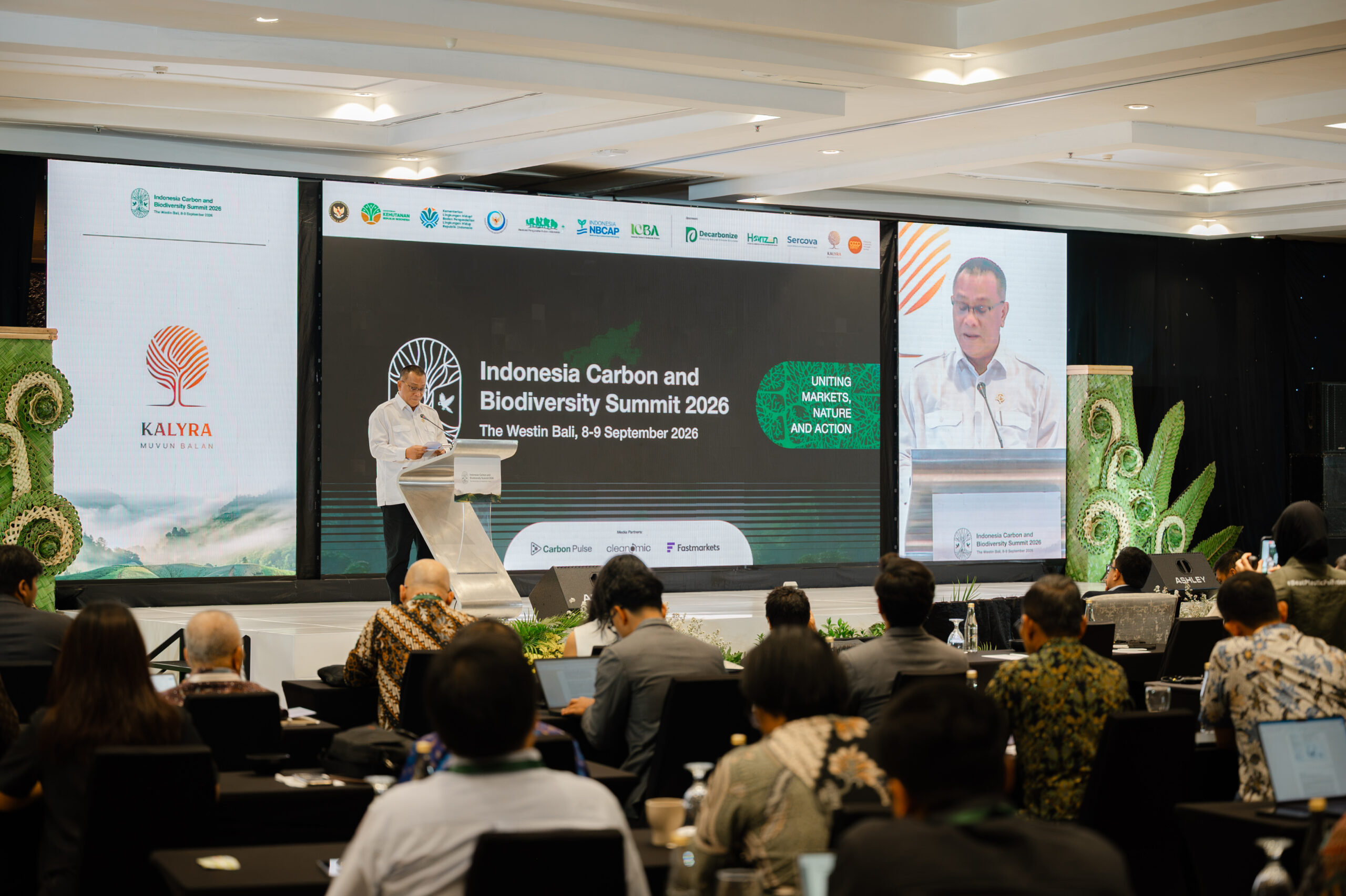
At ICBS 2026 in Nusa Dua, Bali, Indonesia’s Minister of Environment and Head of the Environmental Control Agency (KLH/BPLH), Mohammad Jumhur Hidayat, opened his keynote with a line that reframes how the entire carbon market conversation should be understood: carbon isn’t where climate policy begins. It’s what comes out the other end, once real action has already happened.
That might sound like a technicality, but it’s actually the core logic behind how Indonesia is building its carbon market from the ground up.
The Sequence Matters
In the Minister’s framing, the starting point is never the carbon credit itself. It’s the underlying environmental challenge: emissions from economic activity, degraded ecosystems, inefficient resource use, and mounting pressure on forests, peatlands, coastal areas, and marine ecosystems.
From there, a strict sequence has to play out before anything becomes tradeable. Real action needs to produce a measurable mitigation outcome first. That outcome then needs credible data, a sound methodology, proper reporting, independent verification, safeguards, and clarity on rights and national climate commitment.
Not every environmental project clears that bar and that’s by design, not a flaw. A mitigation outcome that can’t be measured, verified, and traced back to a real, additional action simply shouldn’t become a tradeable credit. No matter how good the intention behind it was.
Where SRUK Fits In
This sequencing logic is exactly what sits behind Indonesia’s new national carbon registry, the Sistem Registri Unit Karbon (SRUK), which the Ministry of Environment officially launched on 9 July 2026 under Ministry of Environment Regulation No. 10/2026, operating within the broader framework of Presidential Regulation No. 110/2025 on Carbon Economic Value Instruments and National GHG Emission Control.
SRUK’s job is to track a carbon unit’s entire lifecycle within a central national system, closing the door on double counting or multiple parties claiming credit for the same outcome. Its launch was paired with the Ministry of Forestry’s first approvals for forestry carbon unit issuance under Forestry Regulation No. 6/2026, and it’s designed for interoperability with Indonesia’s carbon exchange, IDXCarbon, and with international registries and data standards.
What’s notable is where technology sits in this picture. Digital infrastructure like SRUK matters, but as the Minister made clear, technology serves governance and it doesn’t replace it. A well-built registry can’t substitute for a credible baseline, a sound methodology, accurate activity data, or clear rights. It can only make a credible system more traceable and harder to game.
Carbon Integrity Can’t Be Separated From Nature
The keynote also pushed back on a framing that’s easy to slip into: treating forests, peatlands, mangroves, and seagrass as little more than carbon supply. The Minister’s point was that these ecosystems are natural capital first to support biodiversity, livelihoods, food and water security, and long-term resilience, with carbon sequestration as one benefit among several, not the only one that counts.
That has a direct implication for how a carbon claim should be judged. A carbon unit isn’t durable if generating it comes at the expense of the ecosystem or the community that depends on it. Environmental integrity, social integrity, and governance integrity have to move together, not get traded off against each other.
What This Means for Project Developers
For an organization like ours, working as both carbon consultant and carbon project developer across Indonesian forest and peatland ecosystems, this isn’t an abstract policy discussion. It’s the exact governance environment our projects already have to operate within that keep community and ecosystem outcomes central to the project, not secondary to the credit.
The broader signal here is a healthy one for the market. As Indonesia’s carbon infrastructure matures, the bar for what counts as a credible carbon unit is getting clearer and, in some ways, higher. That’s good news for project developers who are already building with integrity as the baseline, not an afterthought and it should make it progressively harder for lower-quality or opportunistic projects to find room in the market.
Working on a conservation challenge? Talk to the Decarbonize Indonesia team about where carbon finance genuinely fits.
Further Reading
- Ministry of Environment of the Republic of Indonesia: official announcement on the SRUK launch (9 July 2026).
- IETA: “Indonesia Opens a New Chapter for the Voluntary Carbon Market”.
- Plan Vivo: coverage of SRUK’s launch alongside first forestry carbon unit approval.
Adapted from the opening session recap shared by ICBA (Indonesia Carbon & Biodiversity Alliance) following ICBS 2026.
Read More Our Articles

Your Strategic Pathway to a Net Zero Future
Or contact us directly

Jl. Prof. Joko Sutono SH No.7, RT.14/RW.6, Petogogan, Kec. Kby. Baru, Kota Jakarta Selatan, Daerah Khusus Ibukota Jakarta 12160
Email: contact@decarbonize.id
WhatsApp: 0813-1406-0000

Jl. Prof. Joko Sutono SH No.7, RT.14/RW.6, Petogogan, Kec. Kby. Baru, Kota Jakarta Selatan, Daerah Khusus Ibukota Jakarta 12160
Kode Pos: 12160
Email: contact@decarbonize.id
WhatsApp: 081234567890
© 2026 Decarbonize Indonesia. All rights reserved.