
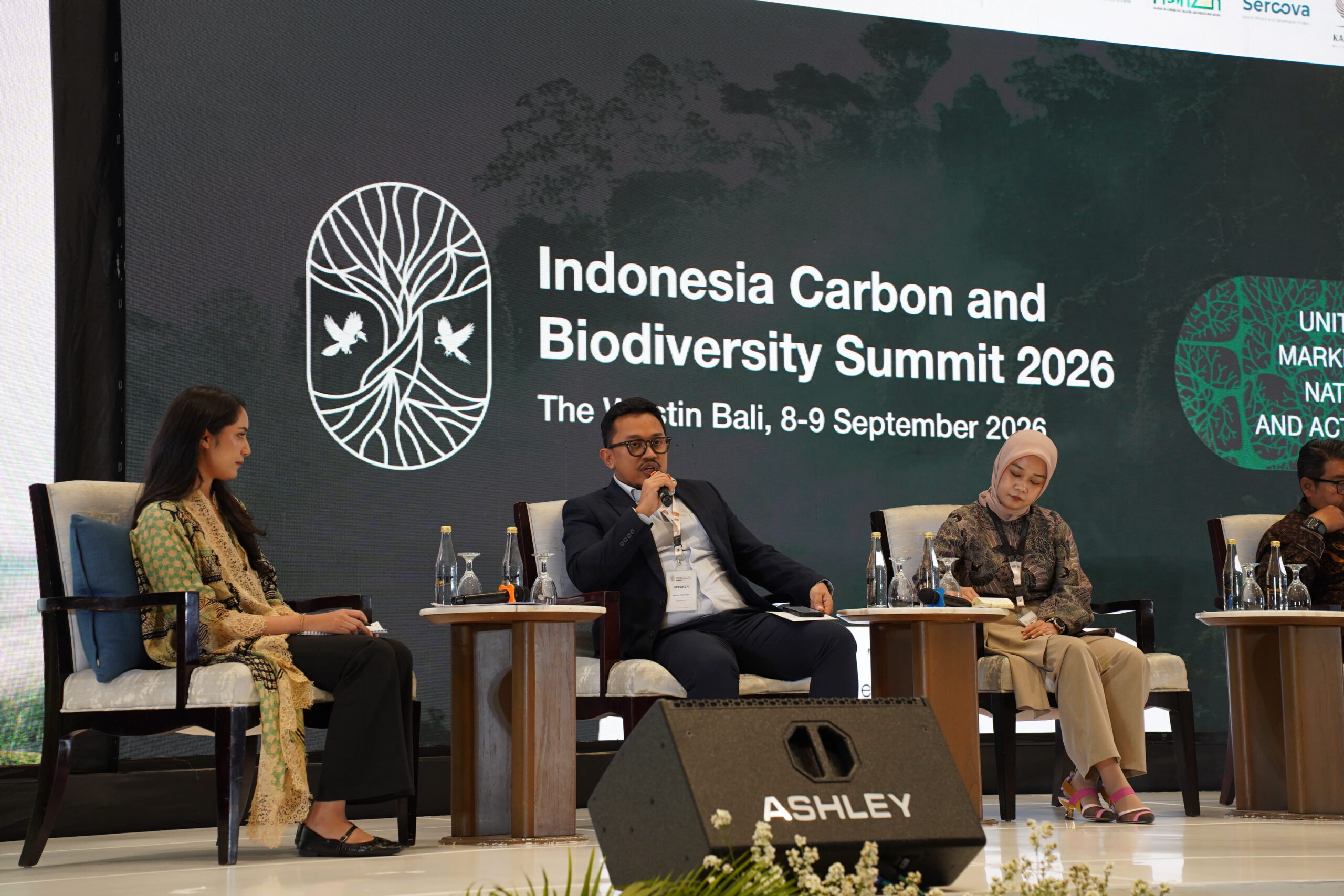
Biodiversity Finance: Building Value Beyond Carbon, a Reflections from ICBS 2026
Biodiversity finance is beginning to move from ambition into market design. The opportunity is significant, but so is the challenge: how do we make nature investable without simplifying the ecological and community outcomes that give it value?
That question sat at the centre of the “Integrating Biodiversity and Local Communities in Nature-Based Markets” session at the Indonesia Carbon and Biodiversity Summit (ICBS) 2026, where our CEO and Founder, Bagus Pratomo, joined a panel of practitioners spanning project development, conservation, policy, and social safeguards.
Carbon’s Lessons Don’t Transfer Cleanly
Carbon markets offer useful lessons in measurement, verification, governance, and claims. But biodiversity is inherently more complex. Species, habitats, ecosystem condition, landscape connectivity, and community relationships are highly localised, and the value of one landscape cannot simply be exchanged for another through a single universal metric.
The session, moderated by Yasmin Jamal of Royal Solusi Karbon, brought together Bagus Pratomo of Decarbonize Indonesia, Wahdi Azmi of IUCN, Dinda Fauzani of the Indonesia Joint Crediting Mechanism Secretariat, and Rizka Afif of Canopy Carbon.
Building Credible Architecture, Not Just Another Credit
From the project-development side, Bagus framed the opportunity as something larger than creating another environmental credit. The real task, he argued, is to build a credible financial architecture that brings private capital into nature while recognising value beyond carbon alone. For nature-based projects, commercial viability ultimately has to sit alongside outcomes for communities and ecosystems.
That requires integrity before scale. Lessons from carbon markets around baselines, ownership, verification, transparent claims, and double-counting remain highly relevant. But as Bagus cautioned, “we should not force biodiversity to become carbon.” Biodiversity needs credible measurement, but reducing forests, mangroves, coral reefs, or endangered species to one interchangeable unit risks losing the ecological information that makes those outcomes meaningful in the first place.
The challenge, then, is to borrow the useful infrastructure from carbon markets without copying the market design wholesale.
The Building Blocks Already in Motion
Dinda’s perspective from the Joint Crediting Mechanism pointed to some of those building blocks already taking shape: clear governance, coordination between institutions, transparent registries, agreed methodologies, and independent verification. The structure may differ from carbon markets, but the underlying need for credible rules and accountable institutions remains the same.
Let Nature Define the Instrument, Not the Other Way Around
The conservation perspective widened the discussion further. Wahdi used the Sumatran elephant to illustrate why biodiversity outcomes rarely sit neatly within a project boundary or a single government mandate. Elephants move through forests, plantations, agricultural land, infrastructure, and communities. Protecting them depends not only on conservation budgets, but on how those wider sectors shape the landscape.
His point was that finance should follow the needs of nature, rather than letting the financial instrument define the conservation objective. As he put it, “a biodiversity credit is a financial instrument. It is not a conservation strategy.” The more important questions come first: what does nature actually need, what has to change, who can influence that change, and where are the resources capable of making it happen?
Communities Come First, Not Last
Communities are equally central to that equation. Rizka’s experience working with Indigenous Peoples and local communities highlighted how different every landscape can be. Customary governance, land use, cultural practices, and local power structures all affect how a project should engage.
His analogy was simple: when entering someone else’s room, knock first. FPIC, participatory mapping, and meaningful consultation are not administrative steps layered around a nature project. They are part of establishing whether the project has legitimacy, whether rights are understood, and whether communities have a genuine role in shaping the outcome.
The Honest Question About Demand
The panel was also realistic about the commercial side. An audience question addressed it directly: where are the buyers for biodiversity credits? Demand remains limited today, which makes sequencing important. Measurement systems, regulation, credible projects, and market infrastructure need to develop alongside buyer demand, rather than assuming that creating a new environmental unit will automatically create a market for it.
What This Means for Indonesia
Taken together, the discussion pointed toward a more useful ambition than simply building the largest possible biodiversity market. The objective should be to create financial structures that make protecting and restoring nature economically sustainable, while preserving the ecological and community outcomes that give nature its value in the first place.
Indonesia holds extraordinary natural capital. The opportunity now is to build the governance, measurement systems, project structures, and community relationships that allow capital to support that value credibly, without reducing nature to something simpler than it really is.
As a carbon consultant and project developer working across Indonesia’s forest and blue carbon landscapes, this is a question Decarbonize engages with directly in our own project work, not just in panel discussions. Building nature-based projects that hold up commercially while genuinely serving communities and ecosystems is the standard we work toward with every project we develop.
Thank you to Yasmin, Bagus, Wahdi, Dinda, and Rizka for a thoughtful discussion on what it will take to bring biodiversity, communities, and finance together more effectively.
Exploring a nature-based project of your own? Talk to the Decarbonize Indonesia team about building it on credible foundations from day one.
This article is adapted from a session recap originally shared by ICBA (Indonesia Carbon & Biodiversity Alliance) following the “Integrating Biodiversity and Local Communities in Nature-Based Markets” panel at ICBS 2026.
Read More Our Articles

Your Strategic Pathway to a Net Zero Future
Or contact us directly

Jl. Prof. Joko Sutono SH No.7, RT.14/RW.6, Petogogan, Kec. Kby. Baru, Kota Jakarta Selatan, Daerah Khusus Ibukota Jakarta 12160
Email: contact@decarbonize.id
WhatsApp: 0813-1406-0000

Jl. Prof. Joko Sutono SH No.7, RT.14/RW.6, Petogogan, Kec. Kby. Baru, Kota Jakarta Selatan, Daerah Khusus Ibukota Jakarta 12160
Kode Pos: 12160
Email: contact@decarbonize.id
WhatsApp: 081234567890
© 2026 Decarbonize Indonesia. All rights reserved.