
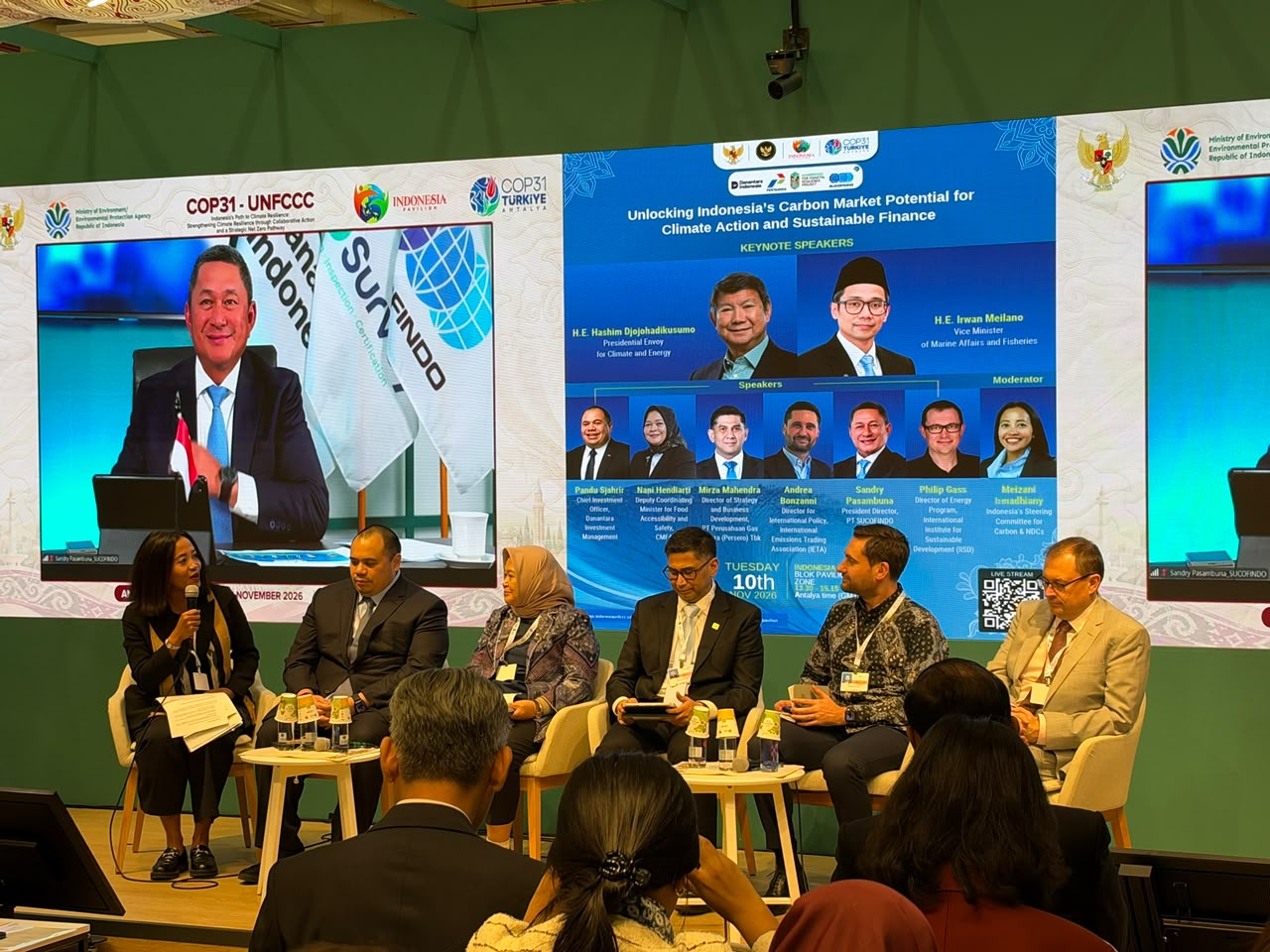
COP31 From the Indonesia Pavilion: What Has Been Announced, and What Still Has to Be Proven
As it nears its close, COP31 in Antalya, Türkiye, is showing an interesting pattern for Indonesia. The Indonesia Pavilion has become a stage for several funding and carbon cooperation announcements, while at home the 2026 forest and land fire season has not fully ended. On 14 November, officials from the Ministry of Environment also said that Indonesia is on the list of potential hosts for COP33, scheduled for November 2028.
Those two things, the announcements in Antalya and the situation on the ground, need to be read together. This article summarizes what has been announced at the Indonesia Pavilion, what still has to be proven, and what the prospect of hosting COP33 means.
The backdrop we shouldn’t forget: the 2026 fire season
The Indonesia Pavilion opened on 9 November with five climate strategies: decarbonizing industry and advancing the energy transition, nature-based solutions, climate action in big cities, climate finance that doesn’t rely only on the state budget, and inclusive climate justice. In the same period, NASA Earth Observatory reported that fire emissions on the Indonesian side of New Guinea had passed 35 million tons of carbon by mid-October, the third highest on record after 1997 and 2015. On 9 November, Indonesia’s disaster agency (BNPB) was still handling 1,434 hotspots covering 5,152 hectares.
This context matters because it shapes how we weigh every announcement: does it change conditions on the ground, or only change the headline?
Three announcements from the Indonesia Pavilion
- Carbonnex: 30 carbon projects on offer (10 November). The Indonesian delegation once again held Carbonnex, a platform for exploring carbon economy partnerships. Environment Minister Jumhur Hidayat said 30 carbon projects from 17 developers were being offered, 19 of them from the forestry and other land use sector. He stressed that the aim was not just to exchange information but to agree on concrete steps to be continued after the COP ends, while acknowledging that carbon projects still face practical challenges on the ground.
- The PLN and GGGI mitigation outcome purchase agreement (11 November). At the Indonesia Pavilion, PT PLN and the Global Green Growth Institute (GGGI) signed a Mitigation Outcome Purchase Agreement (MOPA) under the Article 6.2 bilateral cooperation between Indonesia and Norway. The project is clean energy, including floating solar, with a target of reducing emissions by up to 12 million tons of carbon dioxide equivalent. The agreement follows a letter of intent signed at COP30. Minister Jumhur emphasized that emission reductions must be measurable, verified, and accountable, and pointed to strengthening the national carbon unit registry (SRUK), including meeting the requirements for authorization and recording of international transfers. Norway’s Minister of Climate and Environment, Sigrun Aasland, stressed that carbon payments should be based on results that are actually achieved.
- Norway’s fifth results-based contribution (12 November). Indonesia and Norway announced the fifth Results-Based Contribution (RBC), worth US 100 million, for emission reductions in the forestry and land use sector over 2020 to 2023. The payment rate is US 10 per ton of CO2e, double the US 5 per ton of the previous four phases, which totaled US 216 million. The Indonesian government stressed that implementation must be aligned with the national carbon economic value framework, NDC targets, MRV arrangements, and the national registry. The Ministry of Forestry said it is committed to strengthening forest monitoring together with local governments, communities, and partners.
Reading the announcements critically
All three announcements are meaningful, but each has limits worth understanding.
- A 12-million-ton target is not an issued credit. Reporting describes the MOPA in different ways: some call it the first carbon trading contract, others call it a political agreement covering the potential purchase of up to 12 million tons through 2038. In every case, that volume is still potential. What counts is whether the emission reductions actually happen, and are verified, authorized, and recorded.
- RBC5 recognizes past results. This payment is for verified emission reductions over 2020 to 2023, not for the 2026 fire season. Both can be true at once: Indonesia has verifiably reduced forestry emissions, and 2026 is a severe fire year. Integrity means reporting both.
- A price of US$10 per ton is not a voluntary market price. This is a government-to-government contribution, so it can’t be compared directly with credit prices on the market. It’s better read as a signal that verified forest results are valued higher than in earlier phases.
- Offering 30 projects doesn’t mean 30 deals. The test for Carbonnex is the follow-up after the COP: how many projects reach buyers, under what structure, and with what integrity safeguards.
What this means for the carbon market, biodiversity, and the energy transition
The carbon market. Globally, COP31 is not negotiating new Article 6 rules, so the focus is on implementation. This MOPA is one of Indonesia’s first tests: whether authorization, recording of international transfers, and prevention of double counting through SRUK work the way they’ve been promised.
Biodiversity and habitat. RBC5 pays for results in the forestry sector, and the Deputy Minister of Forestry stressed the role of communities in reducing deforestation and preventing fires. The next question, which is also a benchmark for the Tropical Forest Forever Facility, is whether those benefits reach the communities that protect the forest. For regions like the island of New Guinea, which has the most diverse island flora in the world, the answer shapes the fate of habitat that cannot be replaced.
The energy transition. The MOPA targets clean energy projects through a results-based incentive scheme. But the scale needs context: Minister Jumhur put the financing needed for Indonesia’s emission reduction targets at around US$281 billion, according to Indonesia Business Post. Carbon finance can help, but it isn’t enough on its own, and JETP funding commitments are not the same as disbursements.
The prospect of hosting COP33: an opportunity and a test
On 14 November, Ary Sudijanto, the Ministry of Environment’s Deputy for Climate Change Control and Carbon Economic Value Governance, said Indonesia is on the list of potential hosts for COP33 in November 2028, after China decided not to put itself forward. China’s delegation had asked Indonesia directly about its readiness in a meeting with the minister. South Korea and India had also expressed interest earlier. The government called it a good opportunity, but stressed that readiness is still being assessed and no decision to bid has been made.
The officials themselves named the challenges. 2028 is a political year at home. The conference could bring tens of thousands to around 100,000 delegates, and Indonesia would have to handle accreditation for 168 countries. In Ary’s words, failing to be a good host would be too risky for Indonesia’s reputation.
There’s one more angle that we think is worth considering: international attention cuts both ways. A COP host is judged not only on how smoothly the event runs, but on how strong the evidence is that it can show at home. For Indonesia, that means a few things should already be provable by 2028:
- Fire prevention with measurable results, not just fire suppression.
- SRUK operating with real transactions and transparent recording.
- Forestry and emissions data that is open and consistent across agencies.
- Benefits that demonstrably reach Indigenous and local communities.
In other words, the answer to “is Indonesia ready to host COP33?” isn’t only about hotels and logistics. It’s also about what Indonesia can show the world over the next two years.
Six tests for judging the outcome of COP31
- Is it independently verified? Emission reduction claims need a baseline, measurement, reporting, and a third-party verifier.
- Does the money reach the ground? Look for a breakdown covering prevention, peatland restoration, patrols, and communities.
- Is the data open and consistent? Burned area, hotspots, and emissions should trace back to a clear source.
- Does it address root causes? Peatland drainage, land clearing, and law enforcement need to be part of the discussion, not just offsets.
- Do Indigenous and local communities share the benefits? TFFF’s 20 percent target and the climate justice bill can serve as benchmarks.
- Are there deadlines and accountability? A target that can be checked within 12 months means more than a promise for 2050.
Closing
The Indonesia Pavilion at COP31 showed that real results are being brought home, from recognition of verified emission reductions to the first Article 6.2 cooperation. It also showed how much work remains. Announcements are a beginning, and the real measure only appears when results can be verified on the ground. If Indonesia does step forward as host of COP33, that is the evidence the world will be looking for.
Further Reading
- UNFCCC, Provisional agenda COP31 (Antalya, 9-20 November 2026): https://unfccc.int/sites/default/files/resource/cp2026_01_adv_1.pdf
- ANTARA, “Indonesia masuk daftar calon tuan rumah COP33 pada 2028” (in Indonesian): https://kalbar.antaranews.com/berita/722011/indonesia-masuk-daftar-calon-tuan-rumah-cop33-pada-2028
- ANTARA, “Indonesia considers bid to host 2028 COP33 UN climate summit”: https://en.antaranews.com/news/442759/indonesia-considers-bid-to-host-2028-cop33-un-climate-summit
- CNN Indonesia, “Indonesia Berpeluang Jadi Tuan Rumah COP33” (in Indonesian): https://www.cnnindonesia.com/internasional/20261115064311-106-1427280/indonesia-berpeluang-jadi-tuan-rumah-cop33
- Katadata, “30 Proyek Karbon Ditawarkan di COP31, Indonesia Berburu Investor dan Pembeli” (in Indonesian): https://katadata.co.id/ekonomi-hijau/investasi-hijau/6af3ede696819/30-proyek-karbon-ditawarkan-di-cop31-indonesia-berburu-investor-dan-pembeli
- ANTARA, “Indonesia sepakati kontrak perdagangan karbon pertama di COP31” (in Indonesian): https://kalbar.antaranews.com/amp/berita/721127/ri-sepakati-kontrak-perdagangan-karbon-pertama-di-cop31
- JPNN, “Perdagangan Karbon RI-Norwegia di COP31 Turki, Menteri Jumhur: Pengurangan Emisi Harus Terukur” (in Indonesian): https://www.jpnn.com/news/perdagangan-karbon-ri-norwegia-di-cop31-turki-menteri-jumhur-pengurangan-emisi-harus-terukur
- Akurat, “Indonesia-Norwegia Sepakati Perdagangan Karbon di COP31” (in Indonesian): https://www.akurat.co/politik/906338/indonesia-norwegia-sepakati-perdagangan-karbon-di-cop31-menteri-jumhur-tekankan-pengurangan-emisi-terukur
- Jatengnews, “PLN dan GGGI Teken Perjanjian Karbon Terbesar Indonesia-Norwegia di COP31” (in Indonesian): https://www.jatengnews.id/2026/11/17/pln-dan-gggi-teken-perjanjian-karbon-terbesar-indonesia-norwegia-di-cop31/
- Indonesia Business Post, “Indonesia and Norway sign carbon-credit deal for up to 12 million tonnes”: https://indonesiabusinesspost.com/7825/business-and-investment/indonesia-and-norway-sign-carbon-credit-deal-for-up-to-12-million-tonnes
- Ministry of Environment, press release on the fifth RBC (in Indonesian): https://kemenlh.go.id/news/detail/indonesia-raih-pengakuan-norwegia-indonesia-kembali-kantongi-dana-iklim-rp18-triliun
- InfoPublik, “Norwegia berikan kontribusi USD100 juta atas capaian penurunan emisi Indonesia” (in Indonesian): https://infopublik.id/kategori/nasional-sosial-budaya/997098/norwegia-berikan-kontribusi-usd100-juta-atas-capaian-penurunan-emisi-indonesia
- ANTARA, “Wamenhut: Dana RBC Norwegia bukti keberhasilan Indonesia kurangi emisi” (in Indonesian): https://www.antaranews.com/berita/5849899/wamenhut-dana-rbc-norwegia-bukti-keberhasilan-indonesia-kurangi-emisi
- ANTARA, “Menteri LH: Paviliun Indonesia suarakan lima strategi iklim di COP31” (in Indonesian): https://www.antaranews.com/berita/5842879/menteri-lh-paviliun-indonesia-suarakan-lima-strategi-iklim-di-cop31
- NASA Earth Observatory, “Fires Char New Guinea”: https://science.nasa.gov/earth/earth-observatory/fires-char-new-guinea/
- NU Online, “Karhutla Masih Terjadi di Sumatra-Kalimantan-Sulawesi-Papua” (in Indonesian, 9 November 2026): https://www.nu.or.id/nasional/karhutla-masih-terjadi-di-sumatra-kalimantan-sulawesi-papua-5-152-hektare-lahan-terdampak-TR7Ez
- OPIS, “COP 31 Article 6 Preview”: https://www.opis.com/resources/energy-market-news-from-opis/cop-31-article-6-preview-few-negotiations-but-more-dealmaking-expected/
- Eco-Business, “The Tropical Forest Forever Facility turns one, and is billions short”: https://www.eco-business.com/news/the-tropical-forest-forever-facility-turns-one-and-is-billions-short/
- The Star (Reuters), “Indonesia coal power phase-out plan at risk due to stalled international funding”: https://www.thestar.com.my/aseanplus/aseanplus-news/2025/11/18/indonesia-coal-power-phase-out-plan-at-risk-due-to-stalled-international-funding
- Cámara-Leret, R. et al., “New Guinea has the world’s richest island flora,” Nature (2020): https://doi.org/10.1038/s41586-020-2549-5
Read More Our Articles

Your Strategic Pathway to a Net Zero Future
Or contact us directly

Jl. Prof. Joko Sutono SH No.7, RT.14/RW.6, Petogogan, Kec. Kby. Baru, Kota Jakarta Selatan, Daerah Khusus Ibukota Jakarta 12160
Email: contact@decarbonize.id
WhatsApp: 0813-1406-0000

Jl. Prof. Joko Sutono SH No.7, RT.14/RW.6, Petogogan, Kec. Kby. Baru, Kota Jakarta Selatan, Daerah Khusus Ibukota Jakarta 12160
Kode Pos: 12160
Email: contact@decarbonize.id
WhatsApp: 081234567890
© 2026 Decarbonize Indonesia. All rights reserved.